
The Most Undervalued Position in Youth Sports
Aside from team manager, of course 🤩

Good Game is a 1-2x/week newsletter speaking the language of youth sports parents. Please consider becoming a paid subscriber to support our efforts to educate and empower everyone with a stake in youth sports.
Apologies for the recent radio silence. I was quite under the weather with that lingering cold business that so many seem to have. Luckily, I have no more coughs to give so let’s get to today’s newsletter, shall we?!?
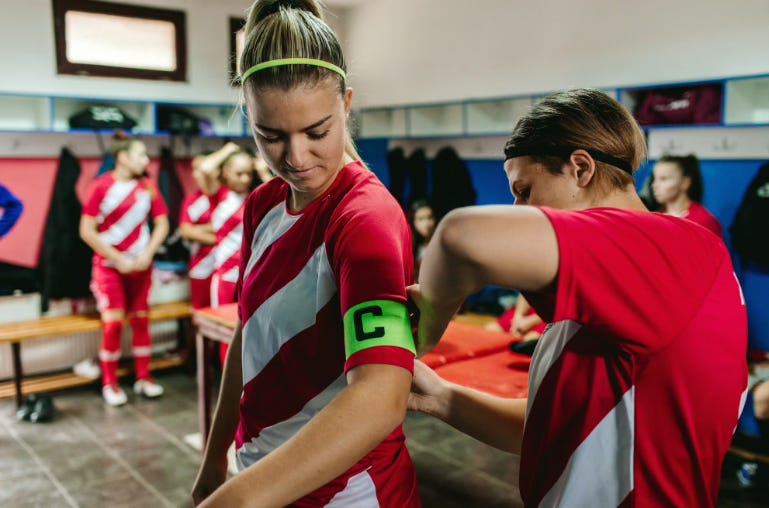
A few weeks ago, I came across a beautiful piece of writing titled, “The Invisible Architecture of Captaincy” from Kwame Twumasi-Ankrah’s Pattern of Play Substack. Twumasi-Ankrah poetically explores captainhood in soccer, a role he deems “the connection between strategy and soul.” From Ghanan captain Asamoah Gyan bearing the weight of a hopeful nation and absorbing the blame after a missed penalty shot in the 2010 World Cup to Japan’s Homare Sawa honoring her tsunami-ravished nation with grace on the way to the 2011 World Cup title, a captaincy transcends the pre-match handshake at midfield.
Of course little kids and teens playing soccer, volleyball or any sport don’t quite have the weight of a nation on their shoulders. And many youth sports don’t utilize captains. But Twumasi-Ankrah’s piece got me thinking of the power of captainhood and how it's too often a missed opportunity in our orbit.
First off, being a captain matters to kids. Handled correctly, it can infuse a kid with confidence and empowerment to lead. Handled without care, as I’ve now witnessed across sports and age groups, and it can feel demeaning and create a sense of disenchantment.
I saw the power of captaincy for my younger son when he was 9. He started as a bench player on his soccer team and was far from captain material on or off the pitch. But he loved the game, obsessively following the sport in real life and FIFA video game form. Thus, at a young age became a player adept at rules and positioning. That alone catapulted him to a starting spot, which in turn inspired him to address a massive weakness - speed. He joined a run club and became noticeably faster. Suddenly he became a kid who cared more about helping his team than acting like a dumbass with his buddies at practice.
When it was time to name a captain, his coach dangled a compelling carrot. The captain wouldn’t automatically be the best or most popular player; they would be named when the coach saw someone put in captain-like effort. My son wanted it bad and the next game hustled more than I’ve ever seen. After being named captain, he felt a sense of pride and responsibility. He wanted to get to every practice and game early. He wanted to help with equipment. Even though he was only 9 and would show up with his shorts on backwards half the time, he wanted to be a captain in more just name. To this day, he likes to tell people he went from bench player to captain, not from bench player to starter.
A youth sports captaincy might not seem like a huge deal on the surface, especially for younger ages, but it is a powerful tool. Too often coaches treat it like a throwaway while they focus on what they deem more important things like x’s and o’s. But embracing the captain role can pay dividends for individual kids and team culture. It can instill everything from better communication skills to a deeper sense of belonging. With captaincy on the brain, here are a few Dos and Don'ts , both incorporating common sense and pitfalls I’ve witnessed.
…
Do set clear guidelines and expectations for the captaincy. Do this at the start of the season. Let the kids have something to strive for.
Don’t make it random and last second. “Oh yeah, you two are standing closest to me so go be the captains today.”
Do name captains for the season or for a game or even weekly basis. Make the announcement in advance so it comes with a sense of pride.
Don’t make it a popularity contest. A player vote only works if they have to name 2 or 3 reasons why that person should be captain.
Do regular check-ins with the captain. Make it come with some tangible responsibility. Older kids should be an extension of the coach.
Don’t have a silly pre-determined rule. My highest IQ player is always my captain is great. My goalie is always my captain is not.
Do let others have a turn at captaincy if it’s earned. This is a great tool for rewarding players for a particularly strong week at practice or who accomplish some goal on their own time.
Don’t automatically name your best player a captain unless that player embodies all of the traits of a captain. Similar to the pre-determined rule except this one comes with a damaging message of valuing talent over all else.
Do offer captain-like opportunities for sports that don’t carry the captain distinction. Every sports team should have some opportunity for leadership. Leading warmups is an easy, yet important, responsibility to dole out.
Don’t name your kid the captain if you are the coach. Sorry, it’s a weird look.
Do offer very young kids playing sports “captain-esque“ jobs. They might be too young to give a rousing pregame speech or help set up equipment, but let the kid who behaved that day pass out stickers. Or have a captain teddy bear that is awarded weekly. Or a coach can try on leadership roles much like preschool and elementary teachers rotates kids as line leaders or light switchers.
Smart, strategic uses of captaincy are dangling in plain sight - yet too often go unused by coaches.
For 8 years now in our U10 cricket team, the role of captain each week is handed over by the captain of the previous week.
The captain selects the batting order, bowling order and wicket keepers for the match.
This allows them the responsibility to learn direction, communicate with their group and gain the feeling of leadership at this age.
Most enjoyable are some of the creative team lists with drawings they bring as their game plan.
I've been coaching flag football for four seasons and have underutilized the captain's role. Will defnitely bring this to our team this spring.