
We Must Keep Talking About Alysa Liu

Good Game is a 1-2x/week newsletter speaking the language of youth sports parents. Please consider becoming a paid subscriber to support our efforts to educate and empower everyone with a stake in youth sports.
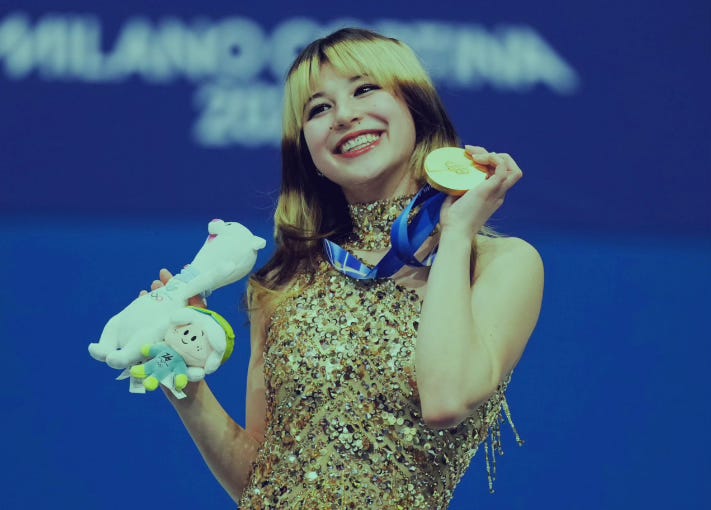
It’s been about two weeks since the women’s figure skating final in Italy, and my town, The Town, can’t get enough Alysa Liu. First there was the massive mural, then the ‘Alysa Gold’ ice cream flavor. Today, the mayor announced a celebration rally next week to honor the first American woman to win an Olympic gold medal in figure skating in 24 years.
Oakland loves its natives, especially when they are unapologetically authentic. Liu, fresh off a flawless Olympic performance filled with a million triple jumps, contorted body spins, and endless joy, personifies independence. Her routine looked effortless because she was competing on her terms. She wasn’t performing for accolades and medals; she was performing for herself. Finally.
There is so much for us youth sports parents to savor from Liu’s journey. Quite frankly, we owe it our kids to keep her top of mind.
Long before Liu stood beaming on the tallest Olympic podium with The Star Spangled Banner blasting, she was a 5-year-old taking group lessons at Oakland Ice Center. Her father, Arthur, was a huge Michelle Kwan fan and it didn’t take Arthur long to realize the next Michelle Kwan could be his daughter. Liu was the definition of prodigy, competing at age 6. By 7, she was competing in national competitions. By 10, she was winning national medals. At 12, she landed a triple axel, and at 13, she was the youngest U.S. national champion ever. Then at 16, just as she was heading into her prime, she quit.
In a since-deleted Instagram post, Liu cited “losing motivation” as the impetus for her retirement just months after finishing sixth at the 2022 Olympics. She later told reporters she was checked out and only there for the Olympic experience, not to actually win gold.
A figure skating prodigy with a normal childhood is an oxymoron. Liu was not the exception. Her father, a single dad raising four other kids, was the ultimate Tiger Dad, laser-focused on coaching and managing his daughter’s blossoming career. Liu was kept on a strict schedule, and at 14, her father shipped her off to the U.S. Olympic Training Center in Colorado Springs to live and breathe figure skating at the highest level. Recently, Arthur admitted that decision was a grave mistake.
“She was upset, and she missed home. But then I was thinking, when I was 14, I went to boarding school. I survived. I felt like [Alysa] can survive this, too. But not knowing that she hated it. I did not know until she came home.’’ Arthur told Yahoo.
While Liu’s friends back home were having sleepovers and navigating teen life, she was isolated.
“I really had nothing going on with my life, you know? Just training,” Liu said in a recent interview with the Associated Press. “I would live at the Olympic Training Center in Colorado, in a dorm by myself. I would eat their food. I went to the rink, skated, ate lunch there, skated some more. Went back to the dorm. I didn’t go anywhere. I didn’t see anything. I was just there,” she said. “And so all that, I was like, ‘Skating is not worth it.’ Like, this is not worth it.’ ”
Liu calls her courageous retirement the “best decision she ever made.”
During her two years away from competitive figure skating, she hiked to Mount Everest Base Camp in Nepal spent more time with family, and enrolled at UCLA to study psychology.
Liu had to step away to fall in love again, which she did two years later after an adrenaline rush on a ski trip with friends. And just like that, Liu redefined what it means to quit.
Ok, so most of our kids are not the next Alysa Liu. But that doesn’t mean our kids aren’t exposed to a litany of pressure in youth sports. There are goal posts at every turn. Even at the basic level, there’s something concrete to achieve. A win. A sticker. A goal that you or someone else decided your kid needed to reach. Assumed they wanted to reach. Like Liu’s father assuming his daughter would want to live in Colorado Springs as a 14-year-old because who wouldn’t mind trading in their childhood to be a world-class skater?
If we learn anything from Liu’s journey of stepping away in her prime and returning on their own terms, it’s that we need to listen to our children.
If they say they hate the sport or the team or want a break or need a break, we have to listen. There are margins, of course, like if your kid wants to skip a particular practice because it’s conditioning day and instead wants to eat a box of thin mints and play PS5 for four hours instead, that’s a different conversation. But if the joy has exited, we need to listen. Our sports goals for our kids might not align with their’s.
It’s a scary conversation to spark because we might hate the answer, especially if we’re one of the many parents who think our kid might be going places. It’s so much easier to think about adjustments. Maybe if I don’t talk about the sport as much or maybe when he’s on a different team or works with a different coach. Believe me, I get it. I’ve lived it with one of my sons and grapple with it with the other
It’s a fine line, and no one wants to encourage their kid to quit. I tried to think of some universal signals that a kid who once loved playing a sport needs a break. Here’s a very basic list of questions to ask ourselves when considering if and how wide an exit lane to offer:
Do they talk about their teammates? Or coach?
Do they tell you something they did in practice, good or bad?
Do they ask when games or practices are?
Do they like watching the sport?
Do they ask to play the sport outside of practice and games?
Did something terrible happen? Did they choke?
Sometimes what seems like the obvious path to us isn’t right for them. After all, isn’t the goal for our kids to feel something akin to the joy emanating from Alysa Liu’s face a few weeks ago.
“Breaks can do wonders for you,” Liu told NBC after winning gold. “I think every athlete should take a break to be honest —actually not just athletes, everyone in general that’s kind of in the same loop in their life. I think it’s very healthy to kind of step back and get a different perspective. I sure learned a lot from it.”
Amen sister.
For the locals….

Amen is right
Have you read this? https://en.wikipedia.org/wiki/Little_Girls_in_Pretty_Boxes It's one of the reasons we never did competitions with our gymnasts (we did displays and stunt shows instead).